The Art of Friction: A Guide to Slab Climbing
To the uninitiated, rock climbing is often synonymous with muscular feats on steep, overhanging cliffs. Popular media frequently depicts climbers dangling by their fingertips from cavernous roofs or leaping dynamically between distant holds on vertical walls. However, within the climbing community, there exists a discipline that stands in stark contrast to these explosive displays of raw physical power. This discipline is slab climbing.
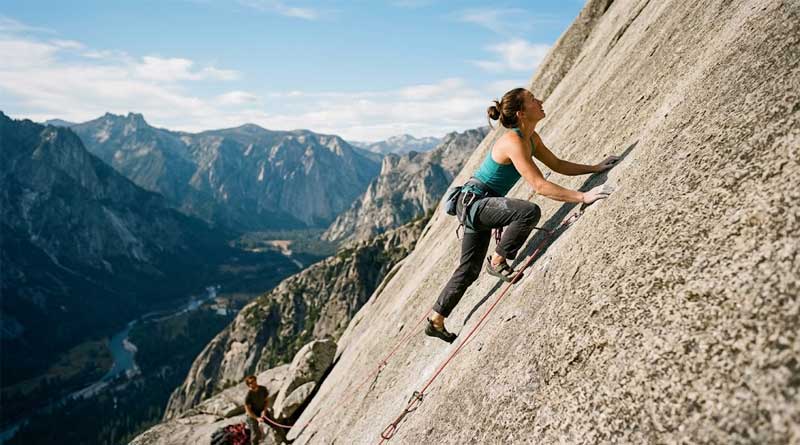
Slab climbing is a nuanced, cerebral, and highly technical style of ascending rock where the cliff face is angled less than vertical—typically between 60 and 80 degrees. Unlike steep climbing, where the primary battle is against gravity pulling the body directly off the wall, slab climbing shifts the focus from upper-body strength to lower-body precision, balance, and psychological fortitude. On a slab, your hands rarely pull you upward; instead, they serve to keep you pressed against the rock while your feet do the literal and metaphorical heavy lifting. It is often described as a delicate vertical ballet, where a millimeter of movement can mean the difference between a triumphant send and a terrifying slide.
The Physics of Slab: Friction and Weight Distribution
To understand slab climbing, one must first understand the fundamental physics that govern it. Because the rock angles away from the climber, gravity acts as both an adversary and an ally. In vertical or overhanging climbing, gravity pulls the climber down and away from the wall. On a slab, gravity pulls the climber down into the rock face, provided their body position is correct. This interaction creates the foundational mechanism of slab climbing: friction.
The Role of Friction
Friction is the resistance that occurs when two surfaces move against each other. In slab climbing, these two surfaces are the sticky rubber of the climbing shoe and the textured surface of the rock. The amount of friction generated is directly proportional to the normal force—the force pressing the two surfaces together. In practical terms, the harder a climber can push down into their feet, the more friction their shoes will generate against the rock. This gives rise to the central paradox of slab climbing: even when a foothold looks completely smooth and non-existent (often referred to as a “blank” slab), it can often support a climber’s entire weight if they have the courage to step down on it with absolute commitment.
Center of Gravity and Body Position
Achieving the necessary normal force requires a radical departure from the body positions used in steep climbing. On overhanging rock, climbers try to keep their hips as close to the wall as possible to keep their weight over their feet and relieve pressure on their arms. On a slab, keeping the hips tight to the wall is a recipe for disaster. When hips are pressed against a slab, the angle of the legs forces the feet to push outward against the rock rather than downward. This outward force reduces friction, causing the shoes to slip.
To counteract this, slab climbers must keep their hips out, away from the wall, positioning their center of gravity directly over their feet. This posture resembles a slight squat or a “bum-out” position. By keeping the pelvis pushed back, the climber’s weight is directed vertically downward through the legs and into the climbing shoes, maximizing the rubber-to-rock friction. While this position may feel counterintuitive to beginners—as it places the face and torso further from the safety of the wall and makes handholds harder to reach—it is the geometric key to unlocking slab movement.
Essential Slab Climbing Techniques
Because slab climbing relies so heavily on the lower body, the repertoire of footwork and movement patterns is incredibly sophisticated. Mastery of these techniques is what separates a frustrating day on the rock from a fluid, successful climb.
Smearing: Trusting the Rubber
Perhaps the most iconic and essential slab technique is smearing. Smearing occurs when there is no discrete, defined ledge or edge for the foot to rest upon. Instead, the climber places the flat sole of the shoe directly onto a sloping or featureless section of rock, utilizing the maximum surface area of the rubber to generate friction.
Successful smearing requires strict adherence to physical principles. The climber must apply continuous, unhesitating downward pressure. If the climber hesitates or tries to “lighten” their weight out of fear, the normal force drops, and the shoe will slip. Furthermore, the angle of the foot matters; lowering the heel slightly can increase the surface area of the rubber in contact with the rock, though dropping it too low can compromise the structural tension of the foot. Smearing is as much a mental hurdle as a physical one, requiring absolute trust in the properties of climbing rubber.
Edging on Micro-Features
While smearing utilizes flat surfaces, edging is the act of standing on tiny, distinct ridges, crystals, or ripples in the rock. On slab terrain, these edges can be incredibly small—sometimes no wider than a credit card. Edging requires using the stiff inner or outer margin of the shoe’s toe box.
Unlike smearing, which favors a softer, more flexible shoe to maximize surface area, edging requires a stiff, supportive shoe that prevents the foot from flexing or rolling off the minuscule feature. Precision is paramount. The climber must place the exact edge of the shoe on the optimal part of the hold on the first attempt; adjusting or twisting the foot once it is weighted can disrupt the fragile equilibrium and cause the hold to break or the shoe to ping off.
Palming and Manteling
While the feet dominate slab climbing, the hands still play a critical role, albeit a supportive one. When positive handholds (holds you can pull on) are absent, climbers resort to palming. Palming is the upper-body equivalent of smearing. The climber presses the flat palm of their hand or the base of the thumb against the rock face, using friction to maintain balance and keep their upper body upright over their feet.
A closely related movement is the mantel. Frequently encountered when topping out a slab or moving past a shelf, a mantel involves pressing downward on a hold with the palms, straightening the arms to lift the torso, and then bringing a foot up onto the same level as the hands. This transition from pulling/stabilizing to pushing requires excellent tricep strength, shoulder stability, and hip flexibility.
Stemming and Opposition
Slab climbs are rarely perfectly uniform flat sheets; they are often found within corners (dihedrals) or open book formations. In these scenarios, climbers use stemming. Stemming is the technique of pressing the feet and hands out in opposite directions against opposing rock faces. By creating a counter-balancing outward pressure, the climber can bridge wide gaps and ascend vertical or near-vertical terrain with minimal traditional holds. Stemming on slabs offers a highly secure, albeit physically exhausting, method of progression, relying on a constant state of structural opposition.
The Mental Game: Fear, Focus, and Commitment
It is often whispered at the crag that slab climbing is 10% physical ability and 90% psychological warfare. While this may be a slight exaggeration, the mental demands of slab climbing are undeniably unique and intensely formidable.
The Illusion of No Holds
From the ground or even from a few feet away, a difficult slab climb can look utterly blank. The human brain, wired to look for solid handles and clear steps, experiences a profound sense of cognitive dissonance when told to climb a surface that appears as smooth as a glass window. Overcoming the initial panic of “there is nothing to hold onto” is the first and greatest mental hurdle. A slab climber must train their eyes to see micro-textures—a slight discoloration indicating a dimple, a tiny grain of quartz, or a gentle ripple in the stone—and possess the confidence to treat these microscopic anomalies as valid pathways upward.
The Fear of the “Slab Slide”
Fear of falling is universal in climbing, but the nature of a fall on a slab is fundamentally different from a fall on steep rock. On an overhanging route, a falling climber drops cleanly through the air, catching nothing but wind before the rope gently catches them. On a slab, gravity ensures that a falling climber remains in contact with the rock. A fall on a slab often results in a cheese-grater effect, where the climber slides down the abrasive, angled rock face before the rope tightens.
This reality makes slab climbing psychologically terrifying. The instinct to survive screams at the climber to lean closer to the wall for safety. However, as established by the physics of slab climbing, leaning into the wall reduces foot friction and directly causes the very slip the climber is trying to avoid. To climb slab safely and effectively, one must override their primal survival instincts, standing tall and leaning out into space over the abyss, committing fully to the feet even when every nerve ending is crying out for retreat.
The Necessity of Calm, Deliberate Movement
On steep terrain, a climber can sometimes muscle through a sequence with speed, momentum, and dynamic bursts of energy. On a slab, dynamic movement is incredibly risky. Jerky movements, sudden lunges, or rapid shifts in weight break the static friction between the shoe rubber and the rock. Once that friction bond is broken, it is exceptionally difficult to regain.
Therefore, slab climbing demands a state of hyper-focus and absolute stillness. Movements must be slow, calculated, and fluid. The climber’s breathing must remain steady, as even the expansion and contraction of the chest during a heavy gasp can alter the center of gravity enough to cause a slip. This high-stakes environment induces a meditative flow state, where the universe shrinks down to the absolute precision of a single toe placement.
Geology and Rock Types
The character of a slab climb is dictated entirely by the geology of the rock. Different rock types offer distinct textures, formatting, and structural features, giving rise to unique styles of slab climbing around the world.
Granite: The Gold Standard of Slab
When climbers think of classic slab, they think of granite. Granite is an intrusive igneous rock characterized by a coarse-grained texture composed of interlocking crystals of quartz, feldspar, and mica. This crystalline structure makes granite incredibly abrasive and high in friction.
Granite slabs are legendary for their blankness. Glaciated granite domes, such as those found in Yosemite National Park or Tuolumne Meadows in California, have been polished smooth by ancient ice sheets, leaving behind massive, sweeping expanses of rock. Climbing granite slab is the ultimate test of smearing and crystal pinching. Climbers must look for individual feldspar crystals to edge on and rely heavily on pure friction smearing across vast sections of blank stone.
Sandstone and Gritstone: Velvet and Velcro
Sandstone, a sedimentary rock composed of sand-sized grains of mineral, rock, or organic material, offers a very different slab experience. Depending on the cementing agent, sandstone can range from soft and friable to incredibly hard. Slabs on high-quality sandstone, like that found in Fontainebleau, France, are famous for slopers—smooth, rounded features that require exceptional palm and body positioning to utilize.
Gitstone, a coarse-grained, porous sandstone found in the United Kingdom, is renowned for its immense friction, often compared to industrial Velcro. Gritstone slabs are short, intense, and requires immense psychological commitment, as the high friction allows climbers to ascend angles that look mathematically impossible, though the texture is notoriously brutal on skin.
Limestone: Smooth and Technical
Limestone is a sedimentary rock composed primarily of calcium carbonate. Unlike granite or gritstone, limestone tends to be much smoother and less inherently high in friction. Limestone slabs often feature pockets, water-worn grooves (runnels), and sharp, precise technical edges.
Because limestone can become polished and slippery over time from the oils on climbers’ hands and feet, slab climbing on limestone requires impeccable precision. It shifts the emphasis slightly away from pure friction smearing toward highly technical edging and complex body positioning inside grooves and corners.
Gear Considerations for Slab Climbing
While climbing gear is largely standardized across disciplines, slab climbing requires specific equipment choices and tuning to optimize performance and safety.
The Anatomy of a Slab Shoe
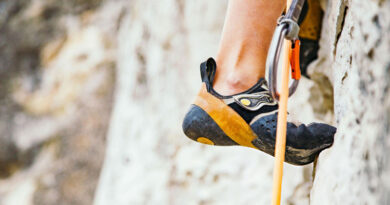
The climbing shoe is the slab climber’s most vital tool. Unlike the aggressively downturned, hook-like shoes used for overhanging sport climbing and bouldering, a slab shoe is typically flat-soled and neutral. This flat profile allows the maximum amount of rubber from the toe to the arch to make contact with the rock during a smear.
The stiffness of the shoe depends on the specific nature of the route:
- Soft Shoes: Preferred for pure friction slabs (like smooth granite or sandstone slopers) because they flex easily, allowing the foot to conform to the contours of the rock and maximize surface area contact.
- Stiff Shoes: Preferred for vertical slabs requiring micro-edging. A stiff midsole provides a rigid platform, preventing the calf muscles from fatiguing rapidly and keeping the shoe from rolling off tiny crystal edges.
The choice of rubber compound is equally critical. Softer, stickier rubbers conform better to microscopic rock textures and provide superior friction, though they wear out much faster. Harder rubbers offer better support for sharp edging and last longer but provide less absolute stickiness on blank surfaces.
Protection and Rope Management
Because slab climbs are angled away from the vertical, placing protection (such as bolts, cams, or nuts) can present unique challenges. On traditional slab climbs, cracks are often rare, leading to long distances between protection points—a scenario known as being “run out.” A 20-foot run-out on an overhanging wall is relatively safe; a 20-foot run-out on a slab means a potential 40-foot slide down abrasive rock.
Furthermore, when lead climbing on a slab, the path of the rope is crucial. Because the rope drags along the rock face beneath the climber, it is subject to immense friction, which can create significant rope drag, making upward movement difficult. Climbers must use long runners or alpine quickdraws to extend their protection points and keep the rope running as straight and freely as possible.
Historical Significance and Icons of Slab
Slab climbing occupies a revered place in the history of mountaineering and rock climbing. Long before the advent of modern sticky rubber, sticky chalk, and indoor climbing gyms, early pioneers were ascending massive slab walls using heavy mountain boots, canvas shoes, or even bare feet.
The Bold Era of the Mid-20th Century
During the golden age of Yosemite climbing in the 1960s and 1970s, slab climbing was considered the ultimate test of a climber’s mettle. Visionaries like Royal Robbins, Yvon Chouinard, and John Bachar pushed the boundaries of what was thought possible on the vast granite walls of El Capitan and Half Dome. Routes were established from the ground up, placing protection bolts by hand while balancing precariously on fragile smears. This era established a culture of boldness and strict ethics, where backing down from a terrifying run-out slab was a test of character.
Johnny Dawes and the Gritstone Revolution
In the 1980s, British climber Johnny Dawes redefined movement on rock, particularly on the gritstone edges of England. Dawes possessed an uncanny, almost supernatural understanding of balance, momentum, and friction. His ascents of routes like “The Indian Face” on Clogwyn Du’r Arddu—a terrifyingly blank, loose, and poorly protected slab—are legendary. Dawes proved that by utilizing dynamic balance and treating the rock not as a ladder of holds but as a continuous canvas of friction, human beings could ascend seemingly vertical sheets of glass.
How to Improve Your Slab Climbing
For many modern climbers who grew up training in indoor gyms characterized by steep walls and large plastic holds, transitioning to outdoor slab can be a humbling experience. However, deliberate practice can yield rapid improvements.
Footwork Drills
The best way to improve slab climbing is to focus intensely on foot placement precision. Practice the following drills on lower-grade terrain:
- Silent Feet: Look at a foothold, place your foot precisely upon it, and do not make a single sound. No scraping, dragging, or re-adjusting. This forces visual focus and deliberate muscle control.
- Glue Feet: Once your shoe touches a hold, it is “glued” in place. You cannot twist, wiggle, or shift its position. This teaches you to commit to the initial placement and adapt your body weight around it.
- No-Hands Climbing: On a very low-angle slab (around 60 degrees), try climbing without using your hands at all. Keep your hands behind your back or out to the side for balance. This forces your hips into the correct position and proves just how much weight your feet can truly support.
Build Core and Mobility
While upper-body pulling power is minimized, slab climbing requires excellent core tension and hip mobility. A strong core acts as the bridge connecting your hands and feet, allowing you to transfer weight smoothly without upsetting your balance. High hip flexibility allows you to bring your feet up high onto edges while keeping your hips in the optimal “out” position away from the wall.
The Undying Appeal of the Slab
Slab climbing is an acquired taste. It does not offer the instant gratification of a powerful dynamic move or the obvious physical pump of an overhanging route. Instead, it offers something deeper: a profound connection to the geometry of the rock and the quiet mastery of one’s own mind.
To successfully ascend a difficult slab is to engage in a conversation with gravity. It requires you to cast aside brute force in favor of elegance, to conquer visceral fear with calm logic, and to trust your life to nothing more than a few square centimeters of rubber pressed against a timeless stone wall. In a sport that increasingly celebrates power and athleticism, slab climbing remains a beautiful reminder that climbing, at its core, is an art of touch, balance, and absolute commitment.