
Best Climbing Anchors of 2025
Climbing anchors are one of the most important parts of staying safe while climbing. They act as the main point that holds the rope and protects the climber in case of a fall. Whether you are climbing outdoors on natural rock or practicing indoors, choosing the right anchor can make all the difference. There are different types of anchors such as bolts, cams, nuts, and slings, each designed for specific situations. Knowing how to pick and use the best climbing anchors is a skill every climber must learn. In this article, we will explore the best climbing anchors and help you understand which ones suit your needs.
1. S.E.PEAK 30KN Climbing Bolt Hanger
- Material: Premium stainless steel, corrosion resistant
- Strength: Rated 30kN (≈ 6,700 lbs)
- Compatibility: Fits 10mm / 3/8″ bolts
- Applications: Climbing, rappelling, rescue, hammock rigging
The S.E.PEAK 30KN Climbing Bolt Hanger is designed for climbers who want confidence in their anchor systems. With a 30kN rating, it provides more than enough strength for demanding alpine routes or vertical rescues. The stainless-steel build ensures long-term resistance to rust, making it a reliable choice for both indoor and outdoor environments. Its hole design allows for quick clipping with carabiners while minimizing wear.
What sets this hanger apart is its versatility. Beyond traditional climbing applications, it is widely used for rigging hammocks, slacklines, and even permanent home training anchors. The edges are rounded enough to reduce rope friction, which helps extend rope life. While it is slightly heavier than aluminum alternatives, the added strength and durability outweigh the trade-off for serious climbers.
Pros
- Exceptional strength rating (30kN)
- Resistant to corrosion in extreme environments
- Universal fit with standard climbing bolts
- Multipurpose use beyond climbing
Cons
- Heavier compared to alloy models
- Price is on the higher side
2. SHINETEC 25KN Climbing Bolt Hanger
- Material: Stainless steel
- Strength: Rated 25kN (≈ 5,600 lbs)
- Compatibility: Designed for 10mm bolts
- Usage: Outdoor climbing, rescue, hammocks
The SHINETEC 25kN Climbing Bolt Hanger balances affordability with safety, making it a good option for recreational climbers. Its 25kN strength rating is more than adequate for most sport climbing or rappelling setups, ensuring dependable performance under load. The stainless steel provides solid corrosion resistance, particularly for outdoor use where weather exposure is common.
While not as heavy-duty as 30kN-rated hangers, it remains strong enough for nearly all climbing scenarios. Its smooth clipping surface allows easy carabiner engagement and reduced rope abrasion. It is especially popular among climbers looking for a cost-effective option without sacrificing too much durability. However, for extreme alpine routes or rescue operations, some may prefer higher-rated hangers.
Pros
- Good balance of strength (25kN) and affordability
- Stainless steel ensures decent rust resistance
- Smooth clipping design
- Fits common 10mm bolts
Cons
- Lower rating than 30kN models
- Not ideal for extreme rescue loads
3. YERGOFE Climbing Holds Anchor Set
- Material: Stainless steel construction
- Strength: Supports up to 2,500 kg load
- Components: Includes bolt hanger and bolt set
- Application: Indoor/outdoor climbing training walls
The YERGOFE Climbing Holds Anchor Set is targeted more toward training and gym setups rather than professional alpine routes. Rated for 2,500kg load, it offers strong support for climbing holds, fixed points, and DIY climbing walls. The included bolt makes it convenient for installation without requiring separate purchases, which is a big plus for beginners or home gym builders.
For outdoor climbers, it can still serve as a solid anchor, though it is not as high-rated in kilonewtons as other dedicated climbing hangers. The set is particularly valuable for those who want a complete solution rather than just the hanger itself. It’s easy to install, reliable, and durable under repeated load cycles, making it a practical choice for training environments.
Pros
- Complete set with hanger and bolt included
- Strong load capacity for gym/training setups
- Easy to install
- Durable for repeated use
Cons
- Load rating expressed in kg, not kN (less standard for climbing)
- Better suited for training than extreme alpine conditions
4. YZTONGPAO 304 Stainless Steel Anchor Bolt
- Material: 304 stainless steel
- Strength: Rated at 30kN
- Compatibility: Fits 10mm bolts
- Applications: Rock climbing, fixed point anchoring
The YZTONGPAO 304 Stainless Steel Anchor Bolt combines durability with high strength, making it a trustworthy piece of equipment. Its 30kN rating places it in the professional range for demanding climbing, ensuring it can handle high forces generated during falls or rescue operations. The use of 304 stainless steel gives it solid resistance against rust, although it is not as corrosion-proof as 316 steel in marine environments.
Its straightforward design makes it easy to clip into, while the build quality provides peace of mind for climbers establishing anchors. For those who climb both indoors and outdoors, this hanger offers a reliable option at a reasonable price. However, if used in coastal or highly humid conditions, additional care may be required to extend its lifespan.
Pros
- Strong 30kN load rating
- Durable stainless-steel construction
- Affordable compared to higher-grade steel options
- Simple, user-friendly design
Cons
- 304 steel less resistant to saltwater than 316 steel
- Slightly bulkier than lighter designs
5. Yuecoom 316 Stainless Steel Bolt Hanger
- Material: 316 stainless steel (marine grade)
- Strength: Large load-bearing capacity
- Compatibility: Fits 10mm (1cm) screws/bolts
- Applications: Climbing, carving, aerial work
The Yuecoom Stainless Steel Bolt Hanger is built with 316 stainless steel, often referred to as “marine grade,” which sets it apart in terms of corrosion resistance. This makes it an excellent choice for climbers operating in coastal areas, canyons, or humid climates where lesser alloys might degrade quickly. The hanger is designed to handle substantial loads, giving climbers reassurance during climbs or work-at-height tasks.
Its versatility is another highlight. Beyond climbing, it is commonly used in aerial rigging, industrial safety setups, and even creative rigging projects like carving installations. While its load rating isn’t specified in kN, it is engineered for demanding use and feels robust in hand. For those who need anchors that last in tough environmental conditions, Yuecoom’s 316 stainless option is a smart pick.
Pros
- Superior corrosion resistance (marine grade steel)
- Long-lasting durability in harsh environments
- Compatible with standard climbing bolts
- Multipurpose use (climbing, work, aerial rigging)
Cons
- No precise kN strength rating provided
- May cost more than 304 stainless alternatives
6. YZTONGPAO Rock Climbing Holds Anchor
- Material: 304 stainless steel
- Strength: Heavy-duty build for secure anchoring
- Bolt Size: Fits 10mm (3/8″) bolts
- Applications: Indoor/outdoor climbing, hammocks, mountaineering
The YZTONGPAO Rock Climbing Holds Anchor is designed for versatile use, ranging from indoor climbing gyms to outdoor highline setups. Made from 304 stainless steel, it offers durability and dependable performance against rust and wear. The heavy-duty design ensures climbers, mountaineers, and even casual hammock users can set secure fixed points with confidence.
Its straightforward installation makes it suitable for those new to rigging, while still being robust enough for more advanced climbing purposes. Though not as highly rated as 316 steel in terms of corrosion resistance, it performs well in most outdoor conditions. The balance between affordability and performance makes this a solid middle-ground anchor for climbers and outdoor enthusiasts alike.
Pros
- Durable stainless-steel construction
- Works well for multiple applications
- Fits common climbing bolts (10mm/3/8″)
- Good balance of strength and price
Cons
- 304 stainless less corrosion-proof than 316
- Bulkier design compared to sport-specific hangers
7. NAXEN 26kN Bolt Hanger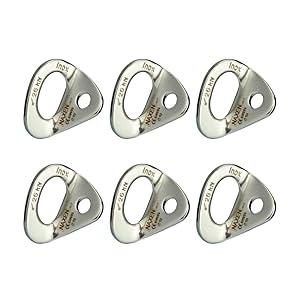
- Material: Stainless steel
- Strength: Rated 26kN (≈ 5,800 lbs)
- Compatibility: Designed for 10mm / 3/8″ bolts
- Usage: Climbing, bolting, anchors
The NAXEN 26kN Bolt Hanger provides a solid option for climbers seeking dependable anchors without going over budget. With a strength rating of 26kN, it sits comfortably within the safe range for sport climbing, indoor walls, and even light alpine use. The stainless-steel build ensures good resistance to environmental conditions, making it suitable for repeated outdoor use.
Its design is straightforward yet effective — carabiners clip in smoothly, and the hanger sits flush against rock or wall surfaces for secure installation. While it doesn’t boast the extreme strength of 30kN hangers, it strikes a balance between affordability, weight, and reliability. For most recreational and semi-professional climbing needs, the NAXEN 26kN offers peace of mind without unnecessary expense.
Pros
- Solid 26kN load rating
- Good corrosion resistance
- Works with standard bolt sizes
- Affordable choice for climbers
Cons
- Slightly less strength than 30kN-rated models
- Not intended for extreme rescue operations
How to Choose Climbing Anchors
Climbing anchors are the foundation of safety in climbing. Whether you are sport climbing, traditional climbing, ice climbing, or setting up a top-rope, the reliability of your anchor system determines the security of the entire climb. Choosing the right climbing anchors is not just about selecting strong gear; it involves understanding the rock or ice quality, the type of climbing you are doing, redundancy, equalization, and how to minimize risks. This guide will walk you through the principles of choosing anchors, the types of anchors available, and practical considerations for building safe and efficient systems.
1. The Role of Anchors in Climbing
In climbing, an anchor is a system of gear and placements that secure the rope to the rock or ice. Anchors serve multiple purposes:
- They provide protection for belays.
- They allow climbers to rappel or descend safely.
- They safeguard against falls by distributing force across secure points.
Since anchors are life-support systems, choosing and building them correctly is one of the most important skills every climber must master.
2. The SERENE Principle
A widely taught guideline in anchor building is the acronym SERENE:
- S – Strong: Each component of the anchor must be strong enough to withstand potential forces. The rock or ice must be solid, bolts must be trustworthy, and gear must be rated for climbing.
- E – Equalized: The load should be evenly distributed across multiple anchor points, reducing the risk of failure if one point breaks.
- R – Redundant: Always back up critical points. Redundancy means having multiple anchor placements and backup knots so no single failure leads to catastrophe.
- E – Efficient: Anchors should be simple to set up, minimize rope drag, and allow quick transitions. Overly complex systems often create confusion and errors.
- N – No Extension: If one anchor point fails, the system should not shock-load the others. Limiting extension prevents sudden force spikes.
Keeping SERENE in mind ensures your anchor is both safe and practical.
3. Understanding Different Anchor Types
a) Fixed Anchors (Bolts, Pitons, Chains)
- Common in sport climbing and popular routes.
- Bolts drilled into solid rock provide reliable protection if well-placed.
- Chains and rappel stations are fixed for descent.
Considerations:
- Check bolt quality and age; rusty or spinning bolts are unsafe.
- Avoid trusting old pitons without backup.
- In remote areas, fixed anchors may not be maintained.
b) Natural Anchors (Trees, Boulders, Rock Horns)
- Large, healthy trees or solid boulders can serve as excellent anchors.
- Rock horns (protruding rock features) can be slung with webbing or cord.
Considerations:
- Always evaluate stability and strength. Avoid dead or shallow-rooted trees.
- Protect natural features with padding to minimize environmental damage.
- Equalize with other points if possible.
c) Traditional Gear Anchors (Cams, Nuts, Hexes)
- Essential for trad climbing, where climbers place removable gear into cracks.
- Cams expand to fit crack sizes, while nuts wedge into constrictions.
Considerations:
- Place gear in solid rock, avoiding loose or hollow features.
- Combine multiple placements for redundancy.
- Learn proper placements through practice before relying on them.
d) Ice and Snow Anchors (Ice Screws, Pickets, V-Threads)
- Used in alpine climbing, ice climbing, and mountaineering.
- Ice screws provide strong protection in solid ice.
- Snow pickets or buried objects can serve as anchors in deep snow.
Considerations:
- Anchor strength depends on ice/snow quality. Avoid rotten or thin ice.
- Redundancy is crucial—back up screws or V-threads when rappelling.
- Always test snow anchors before committing.
4. Evaluating Anchor Placements
Choosing anchors requires a critical eye. Here are key checks:
- Rock/Ice Quality: Strong anchors start with strong rock or ice. Tap rock to check for hollowness, and avoid fractured surfaces.
- Direction of Pull: Place anchors in line with the expected force, usually downward or outward. Misaligned placements can fail under load.
- Redundancy: Always use at least two solid points, ideally three.
- Load Distribution: Equalize placements so each piece shares the load.
- Backups: Backup fixed anchors with gear whenever possible.
5. Common Anchor Configurations
a) The Sliding-X
- A sling or cord is clipped into two anchor points, allowing automatic equalization.
- Advantage: Adjusts to changing force direction.
- Disadvantage: Can extend if one point fails, creating shock-loading.
b) The Overhand Knot in Sling
- Two anchor points are connected by a sling tied with an overhand knot, creating a master point.
- Advantage: Reduces extension.
- Disadvantage: Does not self-equalize if the direction of pull changes significantly.
c) The Quad Anchor
- Popular for top-rope setups. A sling or cord is tied with two overhand knots, creating a master point with limited extension.
- Provides redundancy, equalization, and limited extension.
6. Mistakes to Avoid When Choosing Anchors
- Trusting one piece of gear: Never rely on a single cam, nut, or bolt unless absolutely certain of its reliability.
- Ignoring rock quality: Even the strongest gear fails in weak rock.
- Overcomplicating systems: Too many knots and slings increase confusion and setup time.
- Cross-loading carabiners: Ensure carabiners are loaded along the spine, not sideways.
- Skipping redundancy in rappels: Always back up rappel anchors with another piece or a knot until you’re fully committed.
7. Environmental and Ethical Considerations
Anchor choice also involves responsibility toward nature and other climbers:
- Minimize damage: Use tree protection and avoid excessive gear scarring on rock.
- Respect local ethics: In some areas, bolting is prohibited. Always follow local climbing regulations.
- Leave no trace: If you build temporary anchors, remove all gear and slings when done, unless they serve as fixed protection.
8. Practicing Anchor Skills
Anchor building is a hands-on skill. Reading about it is not enough—you need practice. Ways to improve:
- Practice on the ground: Build anchors at the base of crags and have experienced partners evaluate them.
- Take courses: Many climbing schools offer anchor-building clinics.
- Climb with mentors: Experienced trad and alpine climbers can provide valuable feedback.
- Simulate failure scenarios: Test your anchor configurations in controlled conditions to see how they hold.
Final Thoughts
Choosing climbing anchors is a balance between knowledge, skill, and judgment. While gear strength is important, the real strength of an anchor lies in the climber’s ability to evaluate the environment, use redundancy, and build systems that are both safe and efficient. Remember the SERENE principles, practice regularly, and never cut corners when your life—or your partner’s—depends on the anchor.
In climbing, the anchor is more than just gear; it is the foundation of trust. A well-chosen anchor allows climbers to focus on the climb itself, knowing that their safety system is reliable. With careful selection, thoughtful setup, and a respect for the environment, you can build anchors that provide security and confidence on every adventure.