Best Hangboard for Beginners of 2026
Starting your climbing training can be exciting, but choosing your first hangboard can feel confusing. With so many options, it’s hard to know where to begin. You need something simple, safe, and effective to build your finger strength without getting hurt. This guide cuts through the clutter. We’ll help you find the perfect beginner-friendly hangboard that offers a gentle start, focuses on the basics, and supports your progress as you get stronger.
1. TWO STONES Climbing Hangboard
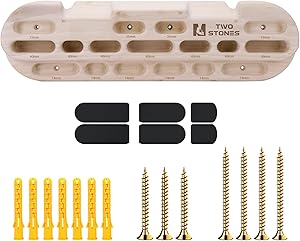
- Material: Solid CNC-milled natural wood
- Grip Types: Jugs, slopes, edges, 2/3/4-finger pockets
- Pocket Depths: 4 depth variations
- Installation: Doorway or wall-mounted with hardware
The TWO STONES Climbing Hangboard is a well-rounded training board designed to support climbers at every stage. Its layout includes outer jugs, dual-angle slopers, multiple pocket depths, and cleanly shaped edges. This variety allows you to simulate real rock holds while targeting finger strength, grip endurance, wrist stability, and core tension. It supports a wide range of exercises, including dead hangs, offset hangs, bent-arm hangs, pull-ups, L-hangs, and front lever progressions.
Crafted from a single block of solid wood, the board feels sturdy and skin-friendly. CNC milling ensures consistent shaping, while polished filleted edges prevent hot spots during longer sessions. The smooth finish reduces finger strain, making it suitable for regular training cycles. Installation is straightforward with the included screws and expansion tubes, and it works well in doorways or on reinforced walls. Overall, it is a dependable hangboard for structured home training.
- Pros: Smooth skin-friendly finish, wide grip variety, beginner to advanced use
- Cons: Backboard not included, limited portability
See the TWO STONES Climbing Hangboard
2. GRIPNATIC FingerPeg 1.0
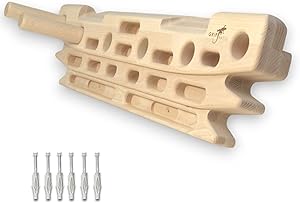
- Material: Class A beech hardwood
- Pocket Depths: 0.6 to 1.6 inches
- Sloper Angles: 20° and 35°
- Max Load: 265 lbs
The GRIPNATIC FingerPeg 1.0 is designed for climbers who want structured finger strength development in a compact format. It features 2, 3, and 4-finger pockets across six depth levels, allowing precise control over training intensity. The addition of warm-up jugs and dual-angle slopers helps diversify sessions and supports progressive overload.
Beyond finger training, this board includes six integrated calisthenics bar holes, making it useful for pull-ups and bodyweight exercises. The finely sanded beech hardwood provides a clean, low-profile look that blends well into home spaces. Installation above door frames or wooden beams takes minimal time and leaves room for natural leg movement. With its durable build and thoughtful design, it works equally well for warm-ups and focused strength blocks.
- Pros: Multiple pocket depths, calisthenics support, strong load rating
- Cons: Limited jug size, indoor-only storage recommended
See the GRIPNATIC FingerPeg 1.0
3. POWER GUIDANCE Wooden Hangboard

- Material: Oak wood handles with rope
- Max Load: 150 kg
- Attachment: 8 mm climbing rope with carabiners
- Use Type: Resistance band and grip training
The POWER GUIDANCE Wooden Hangboard takes a different approach by focusing on grip strength through versatile wooden handles. Designed primarily for resistance bands and cable systems, it supports climbers looking to build pulling strength, forearm endurance, and hand stability off the wall. The wide handle design accommodates all hand sizes comfortably.
Oak wood handles provide a natural grip feel, while the thick climbing rope and steel carabiners ensure durability under heavy loads. This setup works well for warm-ups, rehab sessions, and supplemental strength training. While it lacks traditional finger pockets, it excels as a portable and adaptable training tool that complements hangboard routines effectively.
- Pros: Very durable, versatile training use, comfortable grip
- Cons: Not a traditional fingerboard, limited finger isolation
See the POWER GUIDANCE Wooden Hangboard
4. ebeau Climbing Hangboard
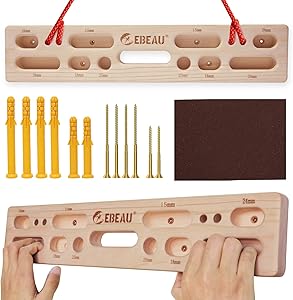
- Material: Solid hardwood block
- Weight: 1.65 lbs
- Dimensions: 19.6 x 4.0 x 1.2 inches
- Mounting: Screws or safety rope
The ebeau Climbing Hangboard is a compact and portable solution for climbers who want flexible training options. It features four finger pockets with varying sizes and depths, allowing focused finger strength development without overwhelming beginners. Its lightweight design makes it easy to carry to the crag or gym.
Made from a single piece of polished hardwood, the board is smooth, splinter-free, and comfortable for repeated use. It can be mounted permanently with screws or quickly set up using the included safety rope, making it ideal for renters or temporary setups. This versatility makes it suitable for both casual sessions and structured training plans.
- Pros: Portable design, smooth finish, flexible mounting
- Cons: Limited grip variety, smaller training surface
See the ebeau Climbing Hangboard
5. MOST GRIP Finger Hangboard

- Material: Premium polished wood
- Grip Types: 2/3/4-finger holes
- Mounting: Rope-hanging or nail-mounted
- Training Use: Finger, forearm, core strength
The MOST GRIP Finger Hangboard stands out for its adaptable mounting options. Users can hang it using the rope system or fix it permanently to a wall, making it suitable for renters and homeowners alike. The multiple finger hole sizes allow climbers to train open-hand grips, crimps, and pinches.
Constructed from durable wood with a smooth, polished finish, the board minimizes skin irritation during longer sessions. It supports a wide range of exercises, including dead hangs, offset hangs, L-sits, and front levers. This makes it a solid choice for climbers progressing through different skill levels while maintaining consistent home training.
- Pros: Flexible mounting, durable wood, wide training range
- Cons: No slopers or jugs, rope setup needs clearance
See the MOST GRIP Finger Hangboard
6. VERTIPEAK Wooden Climbing Hangboard

- Material: Solid beech wood
- Pocket Depths: 0.4 to 1.6 inches
- Sloper Angles: 15° and 45°
- Extras: Sandpapers included
The VERTIPEAK Wooden Climbing Hangboard offers a comprehensive training layout with jugs, angled slopers, and five pocket depths. This range allows climbers to fine-tune intensity and progress safely. It effectively targets finger flexors, forearms, and core stability.
Hand-polished edges ensure comfort and skin safety, even during extended hangs. The included mounting hardware and sandpapers allow users to customize texture and securely install the board. Its sturdy beech construction supports long-term training for climbers focused on power and endurance development.
- Pros: Excellent grip variety, smooth finish, strong build
- Cons: Requires solid wall, heavier than compact boards
See the VERTIPEAK Wooden Climbing Hangboard
7. AWNOM Climbing Hangboard

- Grip Types: Jugs, slopes, edges, pockets
- Mounting: Door-mounted design
- Training Use: Pull-ups and finger training
- Design: All-in-one training station
The AWNOM Climbing Hangboard combines multiple grip styles into a door-mounted training station. It includes jugs, slopes, edges, and pockets, allowing climbers to train finger strength and upper-body pulling power without permanent installation.
This board works well for casual home workouts and warm-ups, especially where space is limited. Its integrated pull-up functionality adds versatility, making it useful for general strength sessions. While it may not offer the depth variety of larger boards, it remains a practical option for convenient indoor training.
- Pros: Easy door mounting, multiple grip styles, space-saving
- Cons: Limited pocket depth info, less advanced progression
See the AWNOM Climbing Hangboard
How to Choose a Hangboard for Beginners
Embarking on your climbing training journey by considering a hangboard is an exciting step. It signifies a commitment to building serious finger strength, the bedrock of climbing performance. For a beginner, however, the sheer variety of hangboards can be overwhelming, leading to poor choices, frustration, or even injury. This guide is designed to demystify the process, helping you select the right training tool to build a solid, safe foundation.
Understanding the Purpose: Why Are You Getting a Hangboard?
Before browsing products, honestly assess your “why.” As a beginner, your primary goal should not be to train at your absolute limit. Instead, a hangboard should be viewed as a tool for:
- Building Foundational Strength: Gradually and safely conditioning your tendons and muscles.
- Learning Proper Form: Developing perfect technique for deadhangs and pull-ups.
- Supplementing Climbing: Adding focused strength work when you can’t get to the wall, not replacing climbing time.
If your aim is to start doing one-arm hangs on tiny crimps next month, reconsider. Patience is the most important piece of equipment for hangboard training.
Key Features to Look for in a Beginner Hangboard
When evaluating different models, prioritize these features that cater to novice needs.
1. Generous, Comfortable Jugs and Deep Slopers
This is the most critical feature for a first hangboard. High-quality, positive jugs allow you to perform pull-ups, dead hangs, and foot-on-the-ground assisted hangs with perfect control. Deep, friendly slopers (around 30-45 degrees) are excellent for training open-hand strength with lower strain on the pulleys. These large holds form the cornerstone of your initial workout routines and warm-ups.
2. A Simple, Progressive Edge Selection
You do not need a board with 15 different edge depths from 1mm to 50mm. Look for a board that offers a logical progression. A great beginner setup might include:
Large Jugs: For warm-ups and pull-ups.
A 20-25mm Edge: This is the gold standard training edge and should be your primary target for two-arm deadhangs.
A 10-15mm Edge: A future goal edge, to be used with extreme caution and only after significant conditioning.
Avoid boards crammed with micro-edges (6mm and below) or monstrously deep pockets; these are for advanced athletes and invite injury for newcomers.
3. Ergonomic Design and Friendly Texture
The board should have a comfortable, not overly aggressive, texture. Sandstone-like textures are popular as they provide good friction without shredding the skin. Rounded, ergonomic rims on edges are easier on the skin and finger joints than sharp, square-cut rims. Feel matters more than you think for consistency.
4. Symmetry and Clear Markings
A symmetrical board with clearly marked, evenly spaced holds allows for balanced training. It helps ensure you’re training both sides of your body equally and makes it easy to find the same hold repeatably, which is crucial for tracking progress.
Types of Hangboards: Mounting Options
Wall-Mounted Boards
These are the classic, permanent training tools. They bolt directly into a stud in a wall, offering the most rigid and secure feel.
Pros: Most stable, often best variety of holds, permanent training station.
Cons: Requires permanent installation and a suitable location (like a doorframe, stud wall, or training space).
No-Mount/Portable Systems
These include systems that attach to pull-up bars or are free-standing. Popular examples are “no-mount” boards that use a rope/cord system over a pull-up bar.
Pros: No drilling required, great for apartments or temporary setups, often easier to adjust height.
Cons: Can feel less stable, may swing or rotate, often have fewer hold options.
For Beginners: If you have a suitable location and commitment, a simple wall-mounted board is excellent. If you’re in a rental or want flexibility, a high-quality no-mount system over a sturdy pull-up bar is a fantastic choice.
What to Avoid as a Beginner
- Overly Complex Boards: Boards with 30+ holds, complex systems, and tiny edges will distract you and increase injury risk. Start simple.
- Boards with Only Small Edges: A board lacking large, friendly holds is not suitable for foundational training or proper warm-ups.
- Poor Quality Materials: Avoid boards with splintering wood, sharp seams, or plastic that feels slick. Your safety depends on the quality of the product.
- The “Pro” Model: Brands often have “Pro” versions of their boards. These are designed for elite climbers. Choose the “Standard” or “Basic” model.
Top Recommendations for Beginner-Friendly Boards
While many brands exist, these are consistently noted for their beginner-friendly features:
- Beastmaker 1000: The classic. Features perfect jugs, a great 20mm and 15mm edge, and comfortable slopers. Symmetrical and wood.
- Metolius Wood Grips II or Prime Rib: Offer excellent large holds, good edge progression, and a gentle texture. The Prime Rib has particularly friendly, rounded edges.
- Tension Basic: A simple, no-frills board focused on a fantastic 20mm edge and large jugs. Excellent for learning the essentials.
- Trango Forge: A great value option with a straightforward, progressive set of holds including superb jugs.
The Final and Most Important Component: Your Training Plan
Choosing the board is only half the battle. How you use it is everything.
- Wait Until You’re Ready: A common guideline is to have at least 6 months to a year of consistent climbing experience before hangboarding to allow your tendons to adapt.
- Learn Perfect Form: Start with feet on the ground, focusing on engaged shoulders (scapular retraction), straight arms in deadhangs, and controlled movements.
- Follow a Beginner Protocol: Use protocols like the “7-Second Repeater” (7s on, 3s off) or “Max Hang” protocols with feet on the ground to reduce load. Never train to failure.
- Prioritize Recovery: Hangboarding is intense on connective tissue. Start with one short session per week, with at least 72 hours of rest after. Never hangboard on a climbing day.
In conclusion, the ideal beginner hangboard is not the most complex or intimidating. It is a simple, well-crafted tool with comfortable large holds and a clear path for progression. By choosing a board designed for foundational training and pairing it with a patient, form-focused approach, you will build the finger strength that unlocks higher grades while staying healthy and motivated for the long climb ahead.